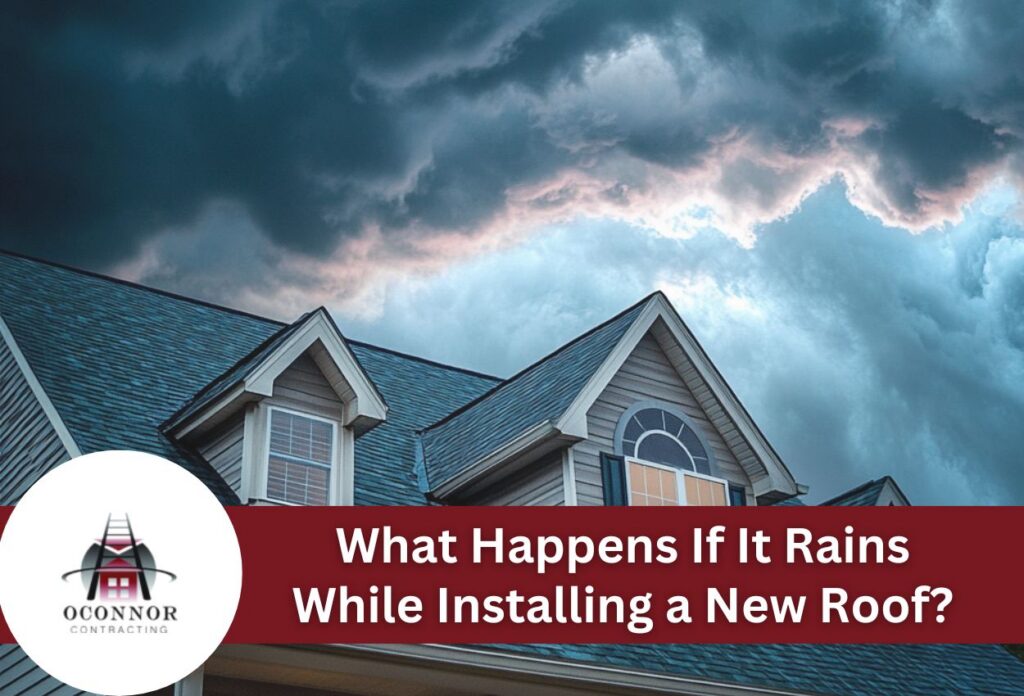

Rain during a roof installation is not a rare surprise in Buffalo, NY. With 3 to 4 inches of rain per month through spring and summer, it’s a realistic part of almost every roofing project. That makes knowing what to do, and what it means for your home, genuinely useful information rather than a worst-case scenario.
Here’s the short answer: light rain hitting fully sheathed roof decking for under 30 minutes carries low risk. But if bare OSB or plywood roof decking stays wet and uncovered for 24 to 48 hours, you’re looking at real problems: swelling, delamination, and mold growth that can damage the structure beneath your new roof before a single shingle goes down.
The actual outcome depends on three things: how long the roof deck was exposed, what material the roof decking is made of, and whether underlayment had already been installed before the rain hit. Each of those variables changes the risk level in a big way.
This article walks through each factor so Buffalo homeowners can make clear, informed decisions when rain shows up mid-project.
*Please note, price ranges listed in this article may not reflect the final cost of your project. Prices are subject to change based on various factors such as local labor rates, material quality, and more. All costs established in this article are rough estimates based on average industry rates.
Will Rain Actually Damage Your Roof Decking During Installation?
Yes, rain can damage roof decking, but the outcome depends heavily on how long the material stays wet and what type of decking your roof uses. OSB’s moisture properties confirm that OSB roof decking can begin to swell after just 2 to 4 hours of direct water exposure and loses up to 20% of its structural strength when fully saturated. Plywood holds up better in short bursts, but risks delamination after 6 to 12 hours of continuous exposure; both figures align with NRCA material handling guidelines for job-site moisture protection.
| Roof Decking Type | Moisture Tolerance Timeframe | Swelling Risk Level | Estimated Replacement Cost per Sheet |
|---|---|---|---|
| OSB | 2 to 4 hours before swelling begins | High | $25 to $45 |
| Plywood | 6 to 12 hours before delamination risk | Medium | $40 to $70 |
The fastest way to reduce saturation risk is to get underlayment installed before rain arrives. It acts as a temporary water barrier that provides the roof decking with meaningful protection. NRCA roofing underlayment guidelines recommend synthetic underlayment over felt for interrupted installations because synthetic material resists moisture far better and stays stable longer when rain hits before the job is finished.
If your contractor installs underlayment in phases as each section of the roof deck goes down, even a sudden Buffalo rain shower carries far less risk than bare roof decking left open overnight. Ask your roofer specifically whether synthetic underlayment is part of the plan for your residential roof installation.
Can Roofers Work in the Rain Safely, or Should Work Stop Completely?
Whether work can continue depends on the rainfall rate. Misting or drizzle under 0.1 inch per hour allows limited non-adhesive tasks to proceed, but anything above that threshold requires a full or partial stoppage. Here’s how to think about it in three tiers:
- Misting or drizzle (under 0.1 inch/hour): Work may continue on non-adhesive tasks only, such as decking repairs or underlayment installation. Shingle installation should not begin because seal strips require dry conditions to bond correctly.
- Light rain (0.1 to 0.25 inch/hour): Halt shingle installation immediately and cover all exposed decking with tarps. Asphalt shingles applied in wet conditions risk granule displacement during the first 6 months, which shortens the roof’s service life.
- Moderate to heavy rain (above 0.25 inch/hour): Full work stoppage required. Tarp every open area, including any roof gaps, to prevent standing water from entering the structure below.
Four conditions require an immediate stop regardless of rain intensity:
- Adhesive seal strips failing to activate: Manufacturer specifications require 40 degrees Fahrenheit or above and dry surface conditions for strip bonding. Wet shingles simply won’t seal correctly.
- Worker fall hazard: Wet roof surfaces remove traction, creating a serious slip risk on any pitch above 4:12.
- Granule displacement on new shingles: Rain contact during installation can loosen granules within the first 6 months, visibly shortening the roof’s lifespan.
- Open gaps exposed to standing water: Uncovered pipe boots, vents, and valleys can channel water directly into the attic within minutes.
In Buffalo, wind gusts during storm fronts frequently exceed 30 mph on the steep-pitched roofs common in the city’s pre-1950s housing stock; that combination makes stopping work a safety and OSHA compliance issue, not just a quality concern. A reputable contractor like OConnor Contracting will call the stop before conditions reach that point, not after.
What Should Your Contractor Do to Protect Your Roof If Rain Hits Mid-Installation?
A responsible contractor should complete four protective steps within 30 minutes of unexpected rain, starting with halting all shingle nailing the moment precipitation begins.
- Halt shingle nailing immediately: Nailing wet shingles drives moisture into the roof decking and prevents seal strips from bonding correctly. Any shingle work in progress stops the moment rain starts.
- Roll out synthetic underlayment over all exposed roof decking: Synthetic underlayment acts as a temporary water barrier and should cover every section of bare roof decks before tarps go down. It holds up far better than felt when soaked.
- Deploy 6-mil polyethylene tarps over any area without underlayment: Tarps should be anchored with sandbags or 2×4 weighted edges, not loose or folded. Any gap allows wind-driven rain to reach the roof deck underneath, especially on steep-pitched roofs common in Buffalo.
- Cover and seal all roof gaps: Pipe boots, valleys, and open vents must be sealed before the contractor steps off the roof. Uncovered gaps can channel water directly into the attic structure within minutes.
Before the project begins, homeowners should ask their contractor two direct questions: Do you carry tarps on-site, and do you have a written rain protocol? In Erie County, where spring and fall precipitation averages 3 inches per month, consistent with NOAA Buffalo climate summary data, a reputable Buffalo contractor treats this as standard practice, not an afterthought. Erie County Home Improvement Contractor licensing includes workmanship accountability, meaning a contractor who leaves roof decks exposed and causes water damage may be liable. Document any uncovered exposure with timestamped photos as soon as possible.
How Long Does Roof Installation Take If It Rains, and What Causes the Delays?
A standard residential roof replacement on a 1,500 to 2,000 square foot home in Buffalo takes 1 to 3 days under dry conditions, but a single rain delay of 4 to 8 hours typically adds 0.5 to 1 full workday, and multiple delays across one project can push total completion time back by 2 to 4 days.
The reason delays stretch that long comes down to moisture readings. Roof decking must fall below 19% moisture content before shingles can go down, a threshold based on NRCA installation standards. After rain, that drying window runs anywhere from 4 to 24 hours, depending on temperature and airflow. In Buffalo’s humid summer conditions, drying tends toward the longer end of that range, which means a mid-morning rainstorm can knock out the rest of a full workday before conditions are safe to resume.
Extended drying time also matters for material exposure. Every hour the roof deck sits bare and damp is time OSB or plywood spends absorbing moisture it shouldn’t. Scheduling a roof replacement during Buffalo’s July to September window reduces the risk of multi-day weather delays because midsummer brings precipitation on roughly 9 to 11 days per month, compared to 12 to 14 days per month in April through June. That difference may not sound large, but across a 3-day project, fewer rain days mean fewer forced stops, faster drying windows, and less overall exposure risk for the structure below.
What Does Rain Damage During Installation Cost to Fix and Is It Covered?
Replacing water-swollen OSB roof decking panels runs $75 to $150 per sheet installed, but that cost climbs fast if the damage goes undetected. Mold caught within 48 hours costs $200 to $600 to remediate on a small section. Wait until the roof is closed up, and that same problem can escalate to $1,500 to $4,000 for full deck replacement on a standard Buffalo home. Early intervention is not just better, it costs a fraction of the alternative.
| Protection Scenario | Estimated Additional Repair Cost | Project Delay | Warranty Impact |
|---|---|---|---|
| No rain protection used | $800 to $4,000 | 3 to 7 days | Voided if moisture damage is documented |
| Partial tarping only | $150 to $600 | 1 to 2 days | Partial risk depending on the exposed area |
| Full underlayment + tarping | $0 to $100 | 0 to 0.5 days | Minimal risk when coverage is complete |
Most standard homeowners’ insurance policies do not cover contractor-caused water damage during active construction, and the liability falls on the roofing contractor’s general liability policy. That is why every Buffalo homeowner should verify their contractor carries at least $1 million in general liability coverage before signing any contract.
Ask for a certificate of insurance, not just a verbal confirmation. If storm damage has already occurred, OConnor Contracting also handles emergency roof storm damage repair for situations that can’t wait. The table above shows the real cost difference between full protection and none, and a contractor who won’t show proof of coverage adds financial risk on top of weather risk.
Ready to Replace Your Roof in Buffalo? Here’s How to Start Without the Stress
Avoiding $800 to $4,000 in water damage repair costs starts with choosing a contractor who treats rain protocols and on-site tarping as standard practice, not an add-on. OConnor Contracting brings hands-on experience with Erie County’s unpredictable weather and Buffalo’s older, steep-pitched housing stock, so the plan for handling a sudden rainstorm is already in place before work begins.
Get your free roof replacement estimate from OConnor Contracting today and find out exactly what weather protections are included in every job. Prefer to learn more first? See how OConnor Contracting handles roofing projects of every scale.