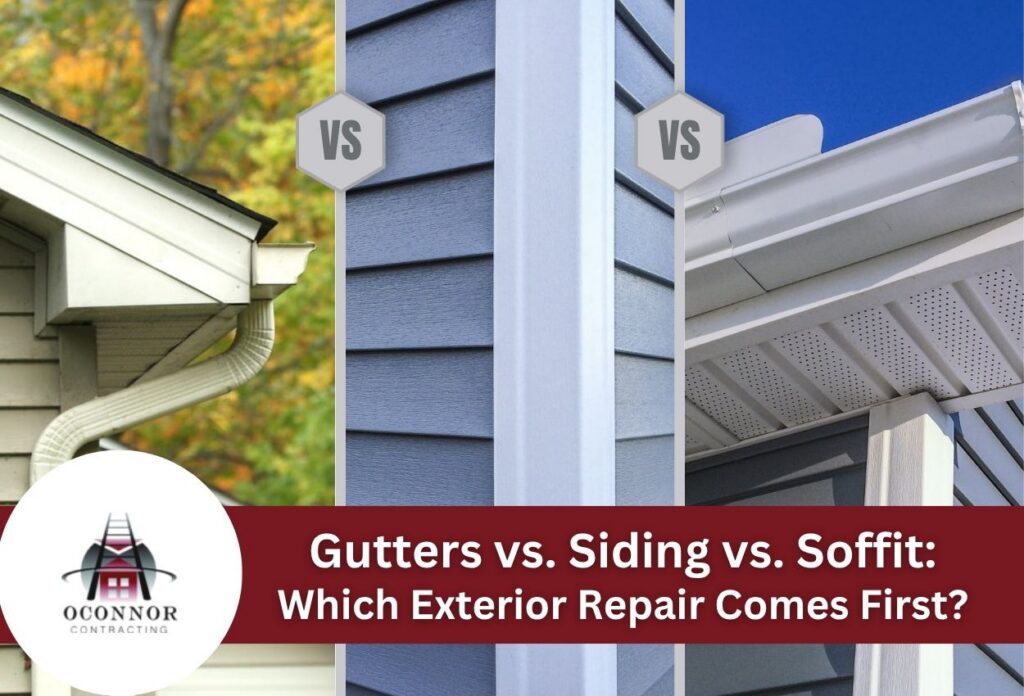

The right sequence is soffit and fascia boards first, then gutters, then siding, and getting it wrong can add 15% to 30% to your total project cost by forcing teardown and reinstallation of work that was already done. Each system connects directly to the next. Soffit and fascia boards set the foundation for how gutters sit and drain. Gutters control where water goes before it reaches your siding. Work out of order, and you are paying twice.
In Buffalo, sequencing is not just a money issue. The area gets 80 to 100 inches of snowfall in a typical year, and relative humidity runs 70% to 80% through the cooler months. Temperature changes hit these systems hard and fast. What starts as a loose fascia board can become a failed gutter, which becomes water-damaged siding all within a single winter season.
These three systems are not independent repairs. They are connected, and one failing component actively degrades the others.
How Do Gutters, Siding & Soffit Actually Connect and Why Does That Affect Which Repair Comes First?
These three systems form a dependency chain: soffit protects the rafter tail and supports attic ventilation, fascia board anchors the gutter, and siding seals the wall below, so failure at any point upstream damages everything downstream. A real-world example: rotted fascia board loses its grip on gutter spikes, the gutter pulls away from the roofline, and water runs directly behind the siding instead of into the downspout. That single failure can turn a $300 fascia board repair into a multi-surface project.
| System | What It Protects | Average Lifespan in Buffalo (Years) | Typical Failure Trigger in Buffalo | Consequence of Delayed Repair |
|---|---|---|---|---|
| Vinyl soffit | Rafter tails, attic airflow | 20 to 30 | Ice dam moisture, animal entry | Rafter rot, attic moisture buildup |
| Aluminum gutters | Foundation, siding, fascia board | 20 to 25 | fascia board rot, heavy snow | Leaks behind siding |
| Vinyl siding | Wall sheathing, insulation | 20 to 40 | Gutter overflow, temperature changes | Sheathing rot, interior moisture damage |
A damaged soffit directly affects siding installation. Most installers require a sound fascia board and soffit before hanging new siding because the wall moisture content must read below 19% per standard installer guidelines. If the soffit is failing and moisture has reached the sheathing, new siding goes over a wet wall, trapping damage underneath. Fix the upstream systems first, then siding goes on clean and stays tight.
What Are the Signs You Need to Replace Gutters Before Siding or Soffit?
Replace gutters before siding any time overflowing gutters are present. Water diverted behind siding can saturate OSB sheathing in as little as one winter season in Buffalo, and wood sheathing above 19% to 20% moisture content creates conditions for mold growth. Knowing which signs demand fast action and which can wait determines your budget and your timeline.
- Critical: address within 30 days: Standing water inside a soffit cavity, fascia board deflection greater than 1/4 inch, or gutter pitch reversal (water pooling instead of draining toward the downspout) all signal active structural risk. These conditions get worse fast once the lake-effect snow season begins in November.
- Critical: address within 30 days: Gutter overflow consistently hitting the same wall section is a direct sign that siding replacement should wait. Replacing siding over a wall that is already absorbing diverted water traps moisture behind new panels and accelerates sheathing damage.
- Moderate: address within 90 days: Soffit vent blockage from paint buildup or debris restricts attic intake airflow and raises interior moisture levels, increasing the risk of condensation at the roof edge. Gutter seam separation under 1 inch also falls here; it is not failing yet, but it will not survive another Buffalo winter untreated.
- Cosmetic: can defer: Faded siding, minor gutter surface oxidation, or small surface scuffs do not affect water management. These can be scheduled in a future season without risking further damage to adjacent systems.
Buffalo’s lake-effect snow season runs from November through February, which compresses the window for catching damage before it escalates. An October inspection and a post-snowmelt inspection in March or April are the two highest-value times to assess all three systems before scheduling any exterior work.
What Does It Cost to Repair or Replace Gutters, Soffit, and Siding in Buffalo?
Soffit repair is the lowest-cost entry point at $500 to $1,500 for a typical Buffalo home, while full siding replacement on a 1,500 sq ft house can run $7,500 to $18,000 or more, depending on material choice.
| System | Material Cost | Labor Cost | Typical Project Total (1,500 sq ft home) | Average Lifespan Post-Installation |
|---|---|---|---|---|
| Aluminum gutters | $10.41 to $15.77 per linear foot | $4 to $8 per linear foot | $1,200 to $2,800 | 20 to 25 years |
| Vinyl soffit & fascia board | $1 to $3 per linear foot | $2 to $5 per linear foot | $500 to $1,500 (repair); $1,800 to $3,500 (full replacement) | 20 to 30 years |
| Vinyl siding | $2 to $7 per sq ft | $3 to $6 per sq ft | $7,500 to $18,000 | 20 to 40 years |
Deferring soffit repair is one of the costlier mistakes Buffalo homeowners make. A $500 to $1,500 soffit fix left undone can escalate into rafter tail rot repair, adding $1,500 to $4,000 to the overall project once structural wood replacement is involved. Permit fees under the New York State Uniform Fire Prevention and Building Code apply when replacing exterior wall assemblies or altering weather barriers; in Buffalo and Erie County, residential exterior work typically runs $75 to $250 in permit fees, and those costs should be factored into any project budget from the start.
The soffit repair vs. siding replacement priority order matters here: fixing soffit and fascia board first at the lower cost protects the structural framing, and that step must be completed before siding costs are committed.
*Please note, price ranges listed in this article may not reflect the final cost of your project. Prices are subject to change based on various factors such as local labor rates, material quality, and more. All costs established in this article are rough estimates based on average industry rates.
What Is the Correct Soffit Repair vs. Siding Replacement Priority Order for Buffalo Homes?
The correct sequence is: (1) assess and repair soffit and fascia board, (2) inspect and repair or replace gutters, (3) install or replace siding last, because installing siding over a compromised moisture envelope voids most manufacturer warranties, which typically require a dry substrate and an intact drainage plane before installation begins.
- Step 1 – Assess and repair the soffit and fascia board first: If the fascia board deflection exceeds 1/4 inch, gutters must be removed before fascia board repair can begin. Skipping this step means rehauling gutters twice, adding labor costs to a job that only needed to be done once. If more than 20% of soffit panels show staining or delamination, full soffit replacement is more cost-effective than spot repair.
- Step 2 – Inspect and repair or replace gutters before any siding work: If gutters are sagging more than 1/2 inch per 10-foot run, rehang or replace them before siding goes on. A sagging gutter misdirects water straight into the wall assembly, exactly what new siding should be protecting against.
- Step 3 – Install or replace siding last: Siding is the final seal on a system that only works when everything behind it is dry and sound. Wall moisture content must read below 19% before siding installation begins. Covering a wet wall traps damage underneath and starts the clock on sheathing rot.
For Buffalo’s older housing stock, especially pre-1960 wood-frame Cape Cods, Colonials, and bungalows, enclosed eaves and limited attic ventilation make soffit ventilation restoration a prerequisite before any other exterior work. Blocked or missing soffit vents restrict attic airflow, raise interior moisture levels, and contribute directly to ice dam formation along roof edges. In many of these homes, restoring soffit ventilation also affects energy code compliance under New York State building standards, making it a functional repair, not just a cosmetic one.
Following this sequence protects every dollar spent on siding, keeps manufacturer warranties intact, and avoids the 15% to 30% cost increase that comes from tearing out and redoing work out of order.
Which Exterior Repair Delivers the Best Return on Investment When You Can Only Do One Project This Year?
Gutters deliver the highest return when only one project is possible. Every $1 spent on gutter repair or replacement prevents an estimated $3 to $5 in downstream structural damage by keeping water away from both the soffit and siding systems at the same time. Vinyl siding replacement returns approximately 67% to 80% of the project cost at resale. But that resale math only holds when the drainage system behind the siding is working.
| Repair | Typical Project Cost | ROI Type | Damage Prevented If Deferred |
|---|---|---|---|
| Gutter repair or replacement | $1,200 to $2,800 | Damage prevention: $3 to $5 saved per $1 spent | Siding saturation, fascia board rot, and foundation moisture |
| Soffit and fascia board repair | $500 to $1,500 (repair) | Damage prevention: avoids $3,000 to $8,000 in rafter and sheathing repair | Rafter tail rot, attic moisture buildup, and sheathing damage |
| Vinyl siding replacement | $7,500 to $18,000 | Resale return: 67% to 80% of project cost | Wall sheathing exposure if gutters and soffit fail first |
Gutters are the single highest-leverage repair because functional drainage protects both the soffit and siding simultaneously. Spending $1,200 to $2,800 on gutters shields a $7,500 to $18,000 siding investment from the water damage that would make it fail prematurely. Soffit repair is the second priority. It costs far less than the $3,000 to $8,000 in rafter and sheathing repair that follows when it is ignored. Siding comes last, and its resale return only applies when the systems underneath it are sound. If budget forces a choice, fix drainage first, structure second, and surface last.
Ready to Prioritize Your Buffalo Home’s Exterior Repairs? Here’s How to Get Started.
Avoiding $3,000 to $8,000 in rafter and sheathing damage starts with a single inspection, and Buffalo’s two best windows are late September through October before lake-effect snow arrives, and March through April after snowmelt. A professional exterior assessment typically takes 45 to 60 minutes and includes a written repair priority report so you know exactly what to fix first.
OConnor Contracting works specifically with Buffalo’s older housing stock and lake-effect climate conditions. Buffalo’s exterior work season runs late May through October, scheduling now keeps your project inside that window before freezing temperatures close it.
Not ready to schedule? Learn more about soffit and fascia board repair services.